“The Gypsy’s Requiem”
Antonio Roman Campos
FICTION
La Ciudad—The City
¡Sevilla! Ah, noble Sevilla, that wonderful Spanish city in the heart of Andalucía, resplendent with its chronicles of long-forgotten lore, its mysterious oriental charms, and its lovely occidental mysteries. Behold the Real Alcázar, the royal palace, with its Moorish archways, its merlon-studded walls, and its roaring lion atop the ancient portcullis. Behold the magnificence of La Giralda, one of the tallest belltowers in all Christendom, the twin of the great minaret of distant Marrakech, yet now adorned with signs and symbols of the Catholic Kings and the weathervane of the great navigatrix. At last, behold the Torre del Oro, the Golden Tower of the ancient Almohad caliphate, with its sturdy octagonal walls watching every corridor of the city, observing every entrance and exit along the River Guadalquivir with panopticon-like charm.
Ah, Seville, that city of stories! That city of Carmen, and Don Juan, and the famous Barber—that legendary factotum who bears the metropolis’s very toponym. That city of Moors and Christians, of Saharan gold and Toledo steel, of wealthy champions and cynical philosophers. Ah, beauteous, generous, quixotic Seville! Ah, mysterious, shadowy, strange Seville! ¡Sevilla, la Perla de Andalucía!
El Gitano—The Gypsy
Manfri, the gypsy, knew the stories of his city well. He knew the stories that he was supposed to know—the histories that had been shared in the time of his grandfather, and even in the time of his grandfather’s grandfather. He knew the stories that he was not supposed to know—the trysts and assignations between young lovers in the night; the heated fights of noblemen that occurred behind closed doors; the innermost thoughts of struggling artists as they threatened to defenestrate themselves into the cobbled streets below. But Manfri also knew other stories. He knew the tales that nobody understood save himself—the tales sung upon the strings of violins by candlelight; the stories told by the birds as they chirped atop the belltower; the legends squeaked by the weathervanes as they twisted in the wind, or whistled by the flames of torches spluttering.
Manfri was an old gypsy, born of an ancient Bohemian line. His age could not be counted in years—for he, himself, did not know how many revolutions he had made about the sun. However, the lines of his creased forehead and the wispy white hairs hanging upon his shoulders spoke volumes of his long and turbulent life. The gentle gleam of his yellowed teeth told others that they had nothing to fear, and yet his eyes nevertheless contained the slightest shade, not of menace, but of singular slyness and otherworldly guile.
Some of Seville’s younger residents believed that Manfri was a clairvoyant capable of reading the thoughts of the dead. Some of the city’s older inhabitants claimed that he was immortal, for the passage of decades appeared to have no effect upon him. Indeed, even the city’s most autumnal denizens could recall Manfri, the gypsy, just as he was today, in the distant annals of their youths.
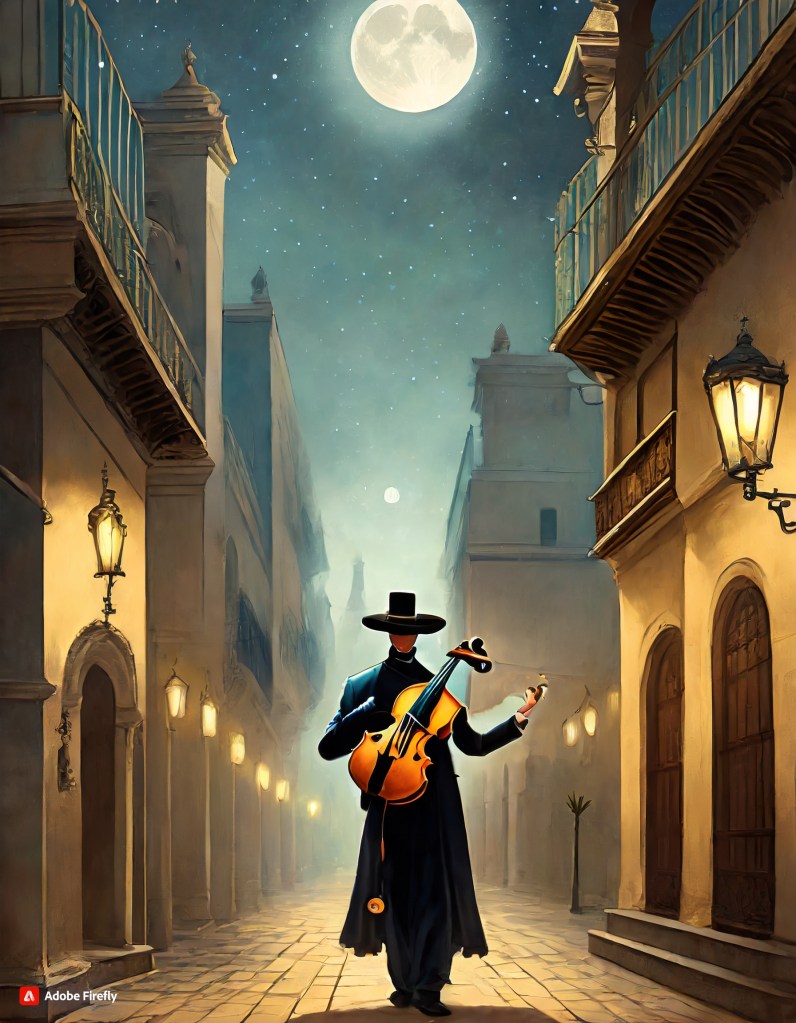
Manfri would wait upon the street corner where Calle de Segovia crossed the Alley of Don Remondo, positioned halfway between the Roman ruins of Calle Mármoles and the tomb of Christopher Columbus at the heart of the Seville Cathedral. Then, as the sun descended into the distant hills and the shadows crept across the faces of the Roman marbles, he would establish himself upon a three-legged stool at the corner, his face as stony and as shadowy as the visages of the ancient gods. From the fringed and torn tendrils of an antique shroud, he would unwrap his prized violin, and from the back of his sturdy leather boot, he would retrieve his musical bow. Then, with a heavy sigh, Manfri would put the instrument to his shoulder and begin to play long, slow, sonorous, nocturnal melodies, that augmented the tropical warmth and enriched the black shadows of the night.
He would sit thus, in intense melodic contemplation, for countless hours as the spirits of the notes swirled about him, and the harps of the ancients whispered down the alleyways. Manfri’s eyes would wink in sleepiness and water with emotion as the archaic chords of his Bohemian ancestry faded into the night, as soft and as tender as the bosom of a newlywed.
The street about Manfri was never quiet. Rather, the sacrosanct atmosphere of the old gypsy’s music would be interrupted and overwhelmed by the profane words of passersby and the discordant rows of drunks in the night. On evening strolls, ladies and gentlemen would pass by the old gypsy without a word, a sigh, or a glance, and yet their shuffling steps were sufficient to spoil the old man’s sanctuary. Boisterous knaves and genteel aristocrats alike were attracted to the numerous tapas bars that lined the Calle de Segovia, and their raucous shouts would disturb the very melodies that their parsimonious coins prolonged.
Indeed, for all his wealth of wisdom, Manfri was a poor and solitary man, supported only through the generosity of others. He could be destroyed, too, by others’ neglect.
For all of the varnish of his pristine violin, Manfri’s toes shown through the tips of his boots, and his aged head was bared to the elements. His lips had not known the taste of fine wine or bread in many days, save for a few parsimonious drops of the Sacrament, and his stomach growled with hunger for less ecclesiastical sustenance. Yet, for all this, Manfri, the poor gypsy, knew the sound of beauty, and he knew how to create it. Manfri, the old gypsy, knew the value of charity, and he survived—or rather subsisted—upon it.
For the world, this night was not so very different. The gypsy played his violin on his happy street corner in Seville. The nighttime pedestrians walked along the road, racing from bar to bar, from scene to scene, and from friend to friend. The walls and parapets of La Giralda stood guard over the magnificent city, obscured by the night and yet prominent in the mind.
Yet, for Manfri, this night was like no other.
It had a sublimity and a profundity uniquely its own.
Indeed, this was the night that Manfri was to die, not from malice nor from violence of any kind, but merely from extreme old age. The apathy and callousness of others in this matter may astound you, Estimable Reader, and yet there is no reason that they should. After all, we are each dead men or women, only awaiting the precise moments of our personal demises. We treat ourselves and others as if we are eternal, and yet nothing could be further from the truth. We do not respect that which should be respected, and we fail to praise that which should be praised. We act as though the ancient amongst us are distant, and therefore we consider them forgotten, yet it must not be so. Are we, too, to be forgotten? A few years from now, are we going to be so very distant from the minds of those we leave behind?
But hush. This is no time for such obvious philosophy.
Manfri, the soon-to-be-deceased, has just uplifted his bow.
Today, he shall play his own requiem mass as he remembers himself and his long, long life. Let us hope that others remember him, and all those like him, in their solitary moments of memorial.
We salute you, ancient gypsy, and we listen to you with patience and contemplation.
El Artista—The Artist
Ambrosio Rocos, the artist, was a young man when first he arrived in Seville at the beginning of the Francoist Dictatorship and the National Regime.
He was as penniless as a beggar, and yet he had a tremendous wealth of that golden substance called ambition.
He promised to become the greatest painter Spain had ever seen.
He had studied the works of the old master Diego Velázquez…
and the realist marvel Francisco de Goya…
and the exiled Pablo Picasso…
and the pious Dominikos Theotokopoulos, who they called El Greco, The Greek.
The artist did not have a criminalistic disposition.
That is to say, he did not look like a criminal from the outside.
But, he always dreamed of being arrested.
The whistles of the social brigade as they chased him through the laneways…
The intensity of the courtroom scene…
The drama of being hauled away to prison just like a revolutionary or a martyr…
These things, he thought, appealed to him.
“An artist must stir up some trouble!” he would say, although he did not know what he meant by it.
“An artist must break the rules!” he would claim, although he could not guess which ones were worth breaking, and which ones ought to remain intact.
“Above all, an artist must envision the future, and paint it upon the canvas!”
Ambrosio failed to uphold this maxim as well.
For as much as the young revolutionary adored the philosophy of progress, he could not help but love old things as well.
He loved the old buildings of the gothic quarter as the shadows crept across their pointed features.
He loved the old paintings in the galleries, with their smooth and realistic lines carefully trained with equal parts art and science.
He loved the old people—the ancient residents and the cryptic denizens—of Seville.
The aged gentlemen in their shabby, patched suits…
The older ladies in their Sunday frocks…
Now just a little tattered or a trifle stained with the memories of forgotten dances, and the thin veneer of respectability…
These were the characters whom most he admired.
They were the ones who remembered, the ones who reflected, the ones who cared.
But, as an artist, Ambrosio had to stir up trouble somehow; he could not sink into the complacency of older generations or admit that he loved the simple, the steadfast, and the sacred.
So, he painted with bold strokes in garish colors.
He reveled in quick, staccato slaps of the brush against the canvas.
There were no kings or emperors to be found in his pieces; there were no smooth countenances to be seen on his Cupids or his Venuses or his Adonises.
Here was the delivery boy running in the street, painted with the same terrific colors of any Goya.
Here was the heavyset grandmother in the window, no longer portrayed with smooth features, but with Picasso’s errant angles.
Here, at last, was the old gypsy on the street corner, his violin reduced to a maddened dash of umber, flashing against a background of enclosing greys and blacks.
The gypsy’s face was downcast in pensive concentration; the melody of his music wallowed in smears of paint and escaped through a tear in the cheap canvas.
The Roman marbles of the background disappeared into a menagerie of pencil-marks, as the street remained unfinished.
The artist yearned to complete the work; he wanted to fill in the missing details.
But no!
Certainly not!
An artist must break the rules after all; he must abandon the masterpiece before its expected telos.
And so, Ambrosio threw the sketch to the ground, half-colored, and cursed himself for his lapse into mundanity.
An artist must envision the future, he reprimanded himself, and this old gypsy is merely stuck in the past.
Las Amantes—The Lovers
La familia Gutiérrez, the Gutierrez family, represented a wealthy and respectable echelon of Spanish aristocracy. Once upon a time, their ancestral patriarch, Don Francisco Gutiérrez de Cuerna de Vaca y Bexar, had owned more land in Perú than King Carlos IV of Spain; he had commanded more forces at sea than Doge Ludovico Manin of Venice; and he had fielded a greater army than General Francesco Sforza of Milan. However, time had not been kind to la familia Gutiérrez, and the fate of the once-powerful dynasty now rested in the hands of an overbearing, yet incapable, buffoon and his two youthful daughters.
These girls—Victoria and Gloria—had been born to wealth and raised in its loving embrace. However, for all the leatherbound books in their family library and all the tireless hours of their tutors, they knew but little of the world beyond their villa, and they could never guess the true dangers of beautiful Seville. These young ladies, in the greenness of their youths, were also hopelessly quixotic and romantic individuals. Much like Queen Isabella II of Spain—La Reina de los Tristes Destinos—this forgivable innocence was destined to lead them to times of sad misfortune.
One evening in the happy month of May, Victoria Gutierrez stumbled across a crisp, wax-sealed envelope, tucked between the leaves of her favorite book of poetry. At first, she was alarmed to think that some person—some stranger—had infiltrated her secluded bedroom and disturbed her most prized book of verse. However, any such infraction into her privacy was quickly forgiven when she opened the envelope and discovered its contents—the careful drawings and tender writings of some secret and wonderful lover. For Victoria, a young maiden barely upon the threshold of adulthood and carefully raised in a cloistered and old-fashioned household, this gran amor, this great love, was incredible and fantastical! The thought of such a surreptitious and mysterious admirer brought rosy blushes to her cheeks and throbs to her heart; the consideration of so secretive a lover was almost too much to endure!
And yet, the pungency of this amor insólito, this unusual and unexpected love, was yet enhanced for Victoria when she decided—against her nature—to keep this feeling a secret to the world. Thus, Victoria did not tell her overbearing father, her trustworthy maid, or even her twin sister about her wonderful letter, and she never inquired as to how the package came to be within her guarded boudoir.
The drawings and poems of the mysterious stranger were gorgeous and romantic. The words of each poem seemed sincere and intense, like the praises and yearnings of some deeply pining gentleman. The images perfectly portrayed the lush foliage and lovely fountains of the Jardines Alcázares and the glorious architectures of the Plaza de España. One image even showed Victoria herself, as seen through her bedroom window in the quiet of the evening while she sat at her desk working at her studies.
Who could be the young woman’s furtive admirer? Some dashing nobleman she had met at court? Some aspiring servant from the hall? Some adoring peasant from the farms surrounding Seville? Victoria could not guess the identity of this distant lover, and yet this made her emotions seem so much more visceral and extreme. What fine sort of a man might adore her so intensely, and yet remain at such great distance? Who was this charming stranger who loved her from afar?
Little did Victoria know, in all of this, that her sister, Gloria, had received an almost identical parcel of letters, tucked beneath the pillow of her bed at the Gutierrez villa. With equal sighing and pining and romantic imagination, Gloria likewise received her parcel of floral paintings and loving letters. Gloria, too, found a lovely watercolor of the Alcazar Gardens, an unstretched canvas of the Spanish Plaza and a quick charcoal of herself, as seen through the window. Gloria, too, kept these quixotic drawings a secret from the world, and Gloria, too, bided her time to discover her secret lover.
As the weeks passed and the beauty of the springtime melted into the hotness of the summer, both gullible heiresses continued to receive their loving notes, and they both continued to secret them away from the world, each ignorant to the actions of the other. Here was a note especially for Victoria hidden on a shelf in the library; here was one for Gloria stashed beneath her vanity. Here was one rolled into Victoria’s equestrian boot, and here was one concealed in Gloria’s dainty jewelry box.
Any other individual might have questioned the letters and worried about the intent of their sender. Any other heiress might have been concerned regarding how some stranger accessed her room or trifled with her belongings. Yet, there could not be any harm in this secret romantic’s actions, could there? He had not stolen anything after all—even when accessing the treasures in the jewelry box. He had not made any improper demands of the girls, or written any scandalous content, or portrayed any undignified art. He could not mean to harm them, could he? He could not mean to hurt them, correct?
Finally, a separate note came for each yearning heiress, asking to meet, secretly, behind the Roman marbles that stood near the corner of the Calle Mármoles and the Calle de Segovia.
So, each young woman made her excuses to the other, claiming that an important social visit or a trinket forgotten in the city compelled her return to Seville. Victoria asked the chauffeur to drive her into town, and she implored the loyal servant not to tell her father or her sister of her actions. At the same time, Gloria concealed herself in a neighbor’s haycart as the estate farmers brought their produce to market. Thus, one young lady carefully made her way to Seville, and thence to the Calle de Segovia, in the back of an expensive coach, as her twin made the same journey upon a peasant’s cart. One heiress wore the black satin gloves, gossamer gown, and shadow lace veil of an older generation, while her sister wore the bright circle skirt and bonnet of a country belle. Both girls were sweetly beautiful, and both were imbued with that characteristic naïveté of their class, which at best is seen as elegance and at worst as foolhardiness. Both yearned for unexpected romance, and both courageously abandoned their comfortable villa with a sensation of determination and independence.
But neither knew whom she would meet, or what trick fate might have in store.
When Victoria and Gloria separately arrived at the Calle de Segovia, an old gypsy played his tender violin upon the corner, his eyes closed in concentration and his head slumped towards the instrument in mortal exhaustion. Victoria arrived some seconds before her sister, and she rushed behind the Roman marbles with enthusiastic skips. Then, when Gloria arrived, she too disappeared behind the statues, quite ready for some secret rendezvous.
How sad each young aristocrat was when she discovered no secret lover! How perplexed each was when she came across the other!
And, all the while, Manfri played his quiet requiem upon the corner, celebrating life’s follies and remembering youth’s disappointments.
And, all the while, Ambrosio Rocos, that deceitful young artist, worked on his sketches of the gypsy as he commended himself for the trick he had played upon the overly romantic and overly covetous aristocrats, each miserly enough to conceal her secrets from the other until it was too late. The artist smirked at the success of his deception, and he chuckled at the trouble he had caused for two young, innocent lovers. They had been compensated for their troubles with small pieces of artwork and poetry, and he had thoroughly enjoyed his little farse from afar, easily bribing the girls’ servants to deposit their packages, and easily watching their changing moods through the villa’s open windows.
Ambrosio thought that his work had been a harmless jest. He considered that he had done his artistic duty by causing trouble, and he figured that the girls would soon enough forget their disappointments.
However, Manfri, the ancient and omnipotent violinist, patiently waited for the girls to return to the street, and he studied their ashamed countenances carefully. He knew that the artist’s jest was unforgivable, and he knew that it was wrong to play so casually with weighty matters like love, longing, innocence, and passion. As sweat beaded upon the old gypsy’s brow, he lugubriously played sonorous, largo chords upon his violin in memory of the girls’ fabricated romance, and, when Victoria and Gloria had departed, he played a dissonant minuet to reprimand the vile artist who had so casually joked with their hearts.
Indeed, the mercurial artist did not deserve Victory and Glory, but only derision for the callous trick he had played.
El Matador—The Killer
The afternoon wore into evening, and the evening descended into night. The artist, throwing his unfinished drawing into the street, disappeared into the nearest bar for a drink. The lovers, only now comparing their secret letters, and only now bonding over their mutual heartache, returned to their estate on foot, each a bit wiser of the world and thus a bit more disappointed by its realities.
Meanwhile, with slow, sonorous notes and grand chords, the gypsy’s requiem neared its completion, and the wizened, old Manfri prepared to die. Out of order, and yet nevertheless recognizable, the venerable man had seen the thrills and excesses of youth, displayed in two quixotic girls; he had viewed the end of youth in the guise of a callous trickster, who claimed to create as an artist, and yet only ever aimed to destroy as a deceiver. Now, Manfri only needed to view a killer in order to end this daily reenactment of life. He needed to see a personification of old age—a literal manifestation of Death himself.
Don Humberto Penáguilas was such a man.
The leading matador of the Plaza de Toros de la Real Maestranza de Caballería de Sevilla, Don Humberto was no stranger to murder. The gallant, grey-haired gentleman, now in the declining years of his life, spent each day in the bullring with those famous tools of his trade—the scarlet cape and the estoque sword—in his hands. Every day, when the whirling toreros cast open the gate to the ring, he watched six bulls charge through la Puerta Grande to the tune of España Cañi.
Each and every bull rushed into the ring, eyes filled with frantic frenzy, as it was led in running circles by the dancing toreros. Every bull flinched and groaned as it received the sharp point of the picador’s lance in its back. Every one roared in agony and jumped in anger at the stick of the banderilleros’ barbs, and every one leaked vibrant blood onto the sand as it bolted around the ring, lowing and growling with fury. Every bull dripped mucus from its nose and saliva from its mouth as it ran in circles, its eyes crazed like those of a rabid dog. Every bull stomped and tramped on the ground, shifting its gaze from the merry brass band to the grotesquely enthralled crowd to the yellow and pink capes of the toreros.
Yes, every bull in the ring was similar, but no two were ever exactly the same.
When Don Humberto leapt into the sand and stared the quaking creature in the eyes, he never knew if this would be simply another bull to fight, his last beast to attack, or the very mechanism of his demise. He never knew which one of them was truly el matador—the killer; would this be the bull’s final hour upon the Earth, or would this be Don Humberto’s?
When the experienced don at last called for his sword and his blood red cape, the moment was just as philosophical—as transcendental—as it was gruesome. This moment was man’s timeless struggle with and against nature, reduced to a single moment, a single heartbeat. Here was civilization—here was humanity—garbed in his rich suit of gold, his necktie, his collar, his cap, his cloak, and there—right there—were fifteen hundred pounds of barbarous hate, pawing at the ground and preparing to charge.
Here was the dance of death, the swirl of the matador with the beast in his sights as the crowd chanted “¡Olé!”. The flash of the sword through the bull’s heart; the stab of the dagger through the brain.
The bull was dead, but Don Humberto lived to fight another day.
The crowd called for one ear… two ears… the tail.
Don Humberto received them all.
It was a triumphant moment in the ring at the bull was pulled away by horses, but the weary don was simply content to have survived it all once again.
Raised as an upstanding aristocrat on a toro bravo ranch on the high plains of Andalucía, Don Humberto Penáguilas was a man who had seen it all. He had seen gentility and stateliness on full display in the Royal Court of Madrid prior to the beginning of Franco’s dictatorship, but he had also seen the brutal fighting in the streets during the Spanish Civil War. Yes, the hesitant matador could be accused of some cruelty and destruction in the ring, but he always recalled a far greater evil than bullfighting—man’s more sincere and personal inhumanity to man.
Following his daily triumph at the Plaza de Toros, Don Humberto was paraded through the streets in the company of his adoring fans. Hats came off for the matador, and flower petals bestrew his path as he toured the Calle de Segovia, enroute to his favorite tapas bar and an aged bottle of tinto de toro wine he had been saving just for the occasion.
Yet, even in his moment of triumph, Don Humberto cared enough to cast his eyes down upon Manfri, the old and reliable gypsy, who quietly lay beside the Roman marbles at the end of the street. Cheers rose from the don’s eager fans as they celebrated their hero of the day, but the curious don requested that the cheers be silent as he listened for the final strains of the gypsy’s requiem. However, the notes had already passed away, and without the fans’ interrupting cheers, the laneway grew mysteriously silent.
There was a proper time for applauding and for booming salutes, Don Humberto understood, and there was also an appointed hour for victory and conquest. There was an age for romantic wiles and the silliness of youth; there was a meaningful moment for revolt against the order of things, and a careful critique of authority; there were even minutes set aside in life for artwork, for beauty, for jealousy, and, indeed, for madness.
But, the matador, who knew death as well as he knew life, glimpsed the profound emotion in Manfri’s expiring eyes, and he realized that this was not the moment for any of these things. This was only the time for quietude and peaceful tranquility.
Great loves, and brutal sports, and vile treacheries had all occurred this day in Seville, showcasing the culmination of long-standing patterns, and unforeseen connections, and outré cross purposes. Affections had been promised, and loves had been lost; minute revolts had been concocted against the organization of the world, and change had been effected on a variety of tiny scales; cheers had been made for daring achievements, and lives had been lost both needfully and needlessly. But all through this, at the margin of the story, the stalwart gypsy had occupied his place and played his violin. This was his day to celebrate and be celebrated. This was his day to remember and be remembered.
Nevertheless, the gypsy was forgotten, just as so many are forgotten, and his gentle requiem had largely gone unheard. Manfri’s work had always provided the background to the affairs and lives of others; for so many years it had added to the ambience and the collective memory of old Seville.
Don Humberto remembered the gypsy’s violin from his youth, but, like so many, he never thought about the music until it had faded away, leaving an empty vacuum in his memory more poignant and more noticeable than the thing that had originally occupied its place.
The gypsy had died.
He had been dead for some time, and yet nobody had cared to notice the fact.
They all had their own lives, and their own deaths to prepare for as well. Who cared about the man on the street? The one who was not an artist or a revolutionary, the one who was neither an aristocrat nor a celebrity. Manfri was simply a street person; a busker; a gypsy. Who needed him?
And yet, without him, we would have no story, no emotion, no meaning, for any of these things without background is worthless. Yes, Seville was our setting, Estimable Reader, but without Manfri, the city became silent; its passion disappeared.
Don Humberto had the profundity to recognize this, even if we did not. He had the humanity to care about the violinist, even if the gypsy’s shoes were worn through and his hat was empty of coin.
There was a man who had lived in the margins; a man who had lived in them and now died in them. There was a man who had reminded Don Humberto—a man who reminded us—to remember to remember.
Those in the margins, and in the background, allow us to enjoy the pride of the foreground and even the spotlight. Those who are simple and unassuming still matter; it is better to remember others here and now, before they are gone and forgotten.
“I know this man,” Don Humberto cautiously claimed, even though he could not recall the gypsy by name. “He has played his violin on this street corner since the days of my youth—since the days of the Romans who built these marbles, most likely! Now, what shall we do for him? A proper burial, at least, seems appropriate. But what else should we have done when we had the chance?”

 antonioromancampos.com