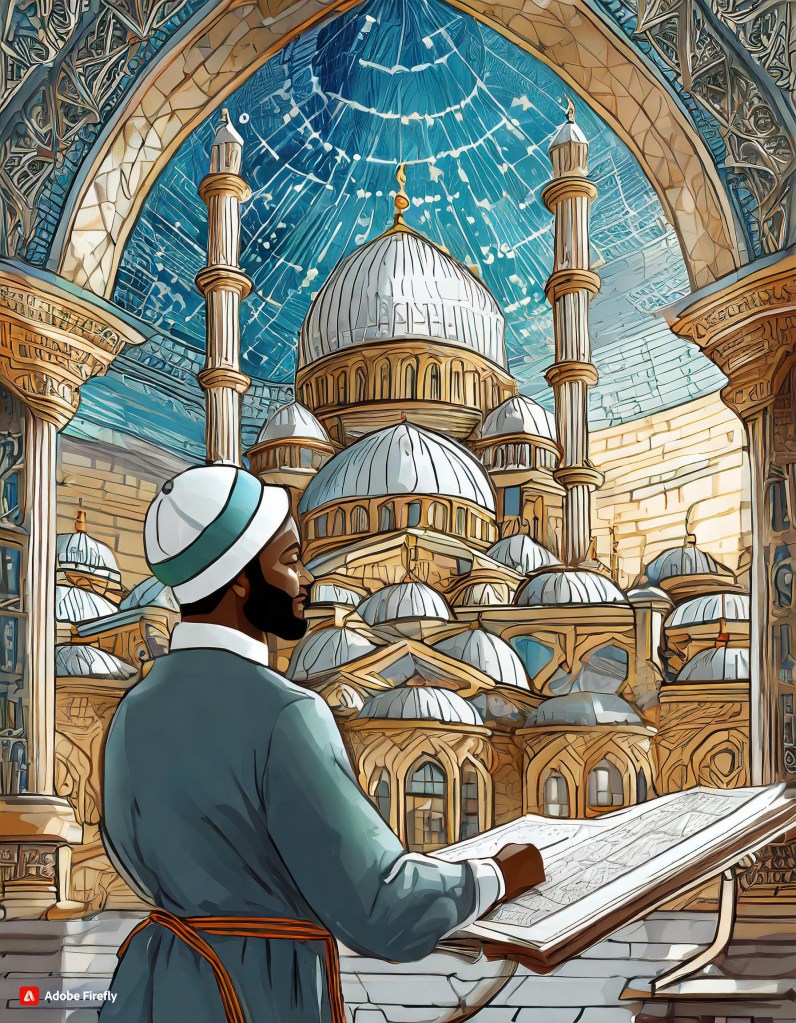
“The Royal Ottoman Mosque of the Ninety-Nine Names”
Antonio Roman Campos
POETRY: METAPHYSICAL AND HAGIOGRAPHICAL
.
I. Preamble to the Reader
Thanks, praise, and glory be to the Creator,
Allah, the One and Only Pantocrator,
Who, to the darkness brought light forth,
And built the foundations of this Earth.
.
Who added to it mountain parapets and heavenly domes,
Rainbow’d arches and cavernous catacombs,
Who did, indeed, build the nine heavenly spheres,
And actuated them according to months, days, and years.
.
He fashioned Adam’s body—his soul, his heart—
And rendered Eve with His singular art.
How wonderous this Creator Who made manifest,
With the letters kaf and nun all that is blest.
.
He adorned with virtue each extant thing,
Yea, to this True Architect, let praises ring!
.
Countless blessings, prayers, and thanks to Allah,
The Architect of the virtuous soul, the heart’s Ka’ba.
Let this charming and humble work find His favor,
And deliver to you, kind reader, a memento to savor.
.
Now, having dedicated this work to munificent Allah,
I turn unto you, generous Sultan, and felicitous Padishah.
.
II. Allegory
Many centuries ago, as our scriptures do tell,
Solomon, David’s son, was king of Israel.
.
About his waist, he wore a mantle of diaphanous silk,
That could ferry him above his ‘land of honey and milk.’
Like a flying carpet, he could ride this mantle with ease,
And command zephyrs to comport him wherever he pleased.
.
This mantle, being five miles long and five miles wide,
Allowed his entire court to float at his side.
And speaking with pride, the king puffed out his chest,
“Behold, I am Solomon! The best and most blest!”
.
But just as Solomon spoke, the wind ceased to blow,
And the mighty King of Israel was made to sink low.
“Return to me winds!” He cried with fuss and with fury,
“Return to me now; I command you to hurry!”
But the winds spurned the king, and dropped him without care,
Into a hellish valley, deserted and bare.
.
Nothing lived in this valley, save an army of ants,
And their queen recognized mighty Solomon with a glance.
She warned, “Lo, it is Solomon, the sinful King of the Jews,
“Make for your holes, my subjects! There is no time to lose!”
.
But Solomon snatched the ant-queen in his hand,
And, screaming in anger, made this demand:
“Who are you, tiny ant, to say I have sinned?
“I am Solomon the wise, the greatest of men!”
.
He wished to throw down the ant-queen or crush her with ease,
But, she forced him to listen, and said, “Spare me, please,
“For, Solomon the Great, you know that I have not lied—
“There is no doubt in your heart that your sin is your pride.”
.
And Solomon the Mighty, that giant among men,
Felt as small as the ant in that moment. And then—
Beginning to see the fault of his ambitious ways,
He begged for forgiveness and offered up praise,
For the tiniest ant who had taught the great king,
That arrogance is a sin and pride a foolish failing.
.
For his hubris, Solomon’s penance was to venture,
To a far-away land where he must serve an indenture,
To beg for his food, and work as hard as a slave,
Until he learned the gift of humility that the ant gave.
.
Now, it was this same Solomon, I know you have heard,
Who built a great temple, commanding genies by word,
He had a magic ring and a staff of great strength,
And he erected his structure twenty-five thousand cubits in length.
.
He was a mighty man, and he became a mighty king,
His fist was like thunder, his wit like lightning.
Yet, for a lack of modesty, he once suffered that ignominious fall,
And if it happened to him, it could happen to us all.
.
And so, I remind you mighty sultan, and you padishah,
That the best of our works do not approach those of Allah.
You have ordered a new temple, built by my hands,
And, as your humble architect, I offer you plans,
.
For a structure of marble, capped in nine splendid domes,
An engineered marvel from crescent to catacombs.
Yet despite my great efforts, and my application of heart,
I humbly remind you that mine is but an imperfect art.
.
III. The Orientation
The mosque I have designed is that of the Ninety-Nine Names,
Beauty in form and in function were my two greatest aims.
Aligning toward Mecca—to the east or south-east—
The qibla and hall of my mosque form an axis of peace.
.
Situated atop a great hill overlooking Golden Horn,
The verticality of my structure will become a beacon to the forlorn.
So much for direction, al-Haytham’s noble trade,
By his calculations of azimuth angles, my foundations are laid.
.
IV. The Central Chamber
Now, on to the structure. I made it august!
Reinforced with marble partitions, thick and robust!
Thirty meters in width, thirty in depth and in height,
The central cube of the structure will sparkle with light.
.
The black marble chosen for the central masjid,
Reminds us of the Ka’ba of Ibrahim, which is square like a grid.
This perfect cube is surmounted by a hemispherical dome,
Filled with the stars, much like Allah’s heavenly home.
.
Wrapped around the great circle of this hemisphere’s equator,
The titular Ninety-Nine Names of Allah will appear,
Crafted in letters of gold to sparkle in the sun,
They will trace out The Merciful to The Patient, every last one.
.
And above these great names and a cloud of blue tile,
The crescent of our most noble sultan offers the shape of a smile.
Below this fine dome, the central masjid prayer-hall spreads out,
Decorated with tile and calligraphy throughout.
The niche of the mihrab is twenty-two meters high,
Ensconced in five levels, each pleasing to the eye.
.
Facing the mihrab, there appears to the left,
The hukar-mahfili, which protects our fair sultan from death;
It is a raised platform with a screened balcony,
Used against assassins so the sultan can rest easily.
Aloft, he can offer his five daily prayers,
While his subjects are near him—just a few feet downstairs.
.
On the right of the mihrab, there arises to higher height,
The minbar, or pulpit, with a small dome in its own right.
The minbar has stairs for the imam, long and straight,
So he can ascend towards the heavens with a dazzling, yet leisurely gait.
.
From below, all can see the imam as he teaches,
And listen on Fridays to the homily that he preaches.
Last but not least in the center of the room,
The muezzin-mahfili rises up like a bloom.
This is for the caller of prayer to give his replies,
To each of the imam’s holy decrees.
.
And above all this space, within the great dome,
The stars of the zodiac, in gold, find their home,
To remind all the faithful of Heaven above,
And to inspire us all on behalf of the precise Deity whom we love.
.
V. The Eight Antechambers
Now, surrounding this central cube, you will see eight more vaults,
Each with identical domes in hues like lapises and cobalts.
.
To the north and the south, these extend over further prayer spaces,
Reserved for the women whom Islam embraces.
For the men is reserved the long western hall,
And the central space of the mosque—the most prized spot of all.
.
Under each smaller dome, some fifteen meters across,
There are great stained glass windows, and other patterns embossed.
There are mosaics of precious and semiprecious stones,
Formed of crushed verdigris, lapis, amethyst, and bones,
Cinnabar from India, and Ruby from Samarkand,
Stones from each corner of the world—every distant land.
.
Rugs as rich and as thick as camelhair adorn the floor,
With decorations opulent and patterns to adore,
Lined from north to south to demark where to pray,
Softly double-knotted to allow the faithful to prostrate and lay.
.
Chandeliers or gasoliers illuminate this space,
But lights are slightly muted to emphasize the romance of the place,
Dark like the cave where The Prophet met the holy Angel,
Illumined from above, light cascading picturesquely down at an angle.
.
At each end of this complex, ablution fountains are found,
But more is to be seen by walking out and around.
At the east end of the site, facing holy Mecca,
There is an imaret, a turbe, kutuphane, and madrasa.
.
In the dome behind the mihrab, the devotee can find,
An ancient Sufi tomb, now converted to a shrine.
A treasury there is also, filled with holy relics and books,
Qurans from the first century, caliphs’ bones, and holy shepherds’ crooks.
.
VI. The Minarets
All of this is looked down upon by minarets,
From which the Adhan is shouted like the boom of barbettes.
For their number, I have chosen a symmetrical four—
These are, indeed, glorious structures that I adore.
.
They represent the four great friends of the Prophet, the rightly guided caliphs—
Abu Bakr, Umar, Uthman, and Ali—their names are written on the marble sheaths.
They rise to a precipitous and dizzying height,
And honor Istanbul’s skyline with their might.
.
VII. The Gardens
Finally, to the elegant gardens, a favorite part of mine,
Their air is filled with flowery nectars—jasmine and citrus divine.
These are gardens of meditation, surrounded by a wall,
Perambulate. Circumambulate. Take in it all.
.
There are trees of Cyprus, Tuba, and Royal Sycamore,
Offering in their shades happiness galore.
.
Four fountains spring from cisterns invisible,
Part by magic and part by sciences physical,
Repeating a fractalated pattern unitary and indivisible.
All the while, water gushes in geysers most mythical.
.
VIII. Conclusion
This is the Mosque of the Ninety-Ninth Name,
Of which you have heard such great acclaim.
.
This is the design that I offer to you—
Oh, worthy sultan, oh, felicitous padishah.
May it be met with blessings, from both of you, and from Allah.
 antonioromancampos.com